Good Practices
Air Quality / Diesel Emission Reduction
Port Clean Air Strategies
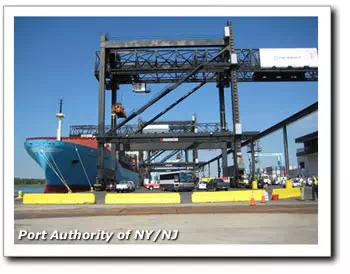
Port Authority of New York and New Jersey Clean Air Strategy
San Pedro Bay Clean Air Action Plan (Long Beach and Los Angeles)
Summary of Subject Matter. US House of Representative hearing on assessing the implementation and impacts of the clean trucks programs at the Port of Los Angeles and the Port of Long Beach.
National Clean Diesel Campaign
EPA National Clean Diesel Campaign
 Incentives Incentives
Emission Reduction Incentives for Off-Road Diesel Equipment Used in the Port and Construction Sectors
This report describes and assesses incentive programs to reduce emissions from off-road diesel engines used in the construction industry and port sector.
Partnerships
The SmartWaySM Transport Partnership Overview
The SmartWaySM Transport Partnership is a voluntary public-private initiative designed to improve the environmental performance of the freight delivery system in the United States through money saving, market-based approaches.
Regional Diesel Collaboratives:
Northeast Diesel Collaborative (EPA Regions 1, 2)
Mid-Atlantic Diesel Collaborative (EPA Region 3)
Southeast Diesel Collaborative (EPA Region 4)
Midwest Clean Diesel Initiative (EPA Region 5)
Blue Skyways Collaborative (EPA Regions 6, 7 plus Minnesota)
West Coast Collaborative (EPA Regions 9, 10, w/Canada and Mexico)
Clean Diesel Technologies and Strategies
EPA New England Options for the Marine Ports Sector: Green Strategies for Sustainable Ports (June 2008)
This document provides marine port authorities and terminal operators with an overview of strategies that can be implemented to reduce air emissions from daily operations.
Port Technologies and Management Strategies
A web-based tool developed by EPA New England to help stakeholders familiarize themselves with a variety of diesel emission reduction technologies and strategies for ports, terminals and vessels
Tug Boat Study (March 2009) - Tug/Tugboat Emissions Feasibility Study
Model Construction Specifications
In order to control diesel emissions from construction projects, ports can incorporate these model contract specifications.
Pollution from Rail Yard Emissions
Chicago Reporter
Climate Change
International Association of Ports and Harbors (IAPH) Air quality and Greenhouse Gas Tool Box. This Tool Box provides information on air and climate issues and their relationship to port and maritime activities. Based on actual port experiences, it describes strategies to reduce emissions and guidance on how to develop a Clean Air Program and a Climate Protection Plan. Strategies such as repowering older engines, applying effective technologies for efficiency and emission control, and using alternative and cleaner fuels in maritime operations will dramatically reduce air pollution and greenhouse gas emissions.
http://iaphtoolbox.wpci.nl/index.html
World Port Climate Initiative. Fifty-five of the world’s key ports, acknowledging their unique capacity as key hubs in global supply chains, have come together in a commitment to reduce their greenhouse gas emissions while continuing their role as transportation and economic centers. Important information on reducing your carbon footprint, sustainable lease agreements, on-shore power supply, etc. The U.S. port members include Port of Seattle, Port of Los Angeles, Port of Long Beach, Port of Houston Authority, NY/NJ Port Authority.
Community Relations
Masonville Cove - The Port of Baltimore and the Maryland Port Administration success story about a sustainable dredging project for Masonville Cove. An excellent example of community involvement through a harbor team process.
Community Action for Renewed Environment (CARE). The Community Action for a Renewed Environment (CARE) program is a competitive grant program that offers communities an innovative way to address the risks from multiple sources of toxic pollution in their environment.
CARE Case Study.
Port of Portland Environmental Outreach and Communication Program - AAPA 2007 Environmental Awards Competition 2007.
Dredged Material Beneficial Use
US Army Corps of Engineers and the Port of Baltimore - Poplar Island
New Bedford portfield project
Portfields Interagency Initiative, Phase I, Fall 2003
Greening Ports
Environmental Management Handbook. AAPA, through its Harbors, Navigation and Environment (HN&E) Committee, has completed an Environmental Management Handbook designed to assist ports in effectively managing their environmental issues.
America's Green Ports: Environmental Management and Technology at US Ports (Mar. 2000). This report is a compendium of case studies presenting a selection of innovative and cost-effective management practices and technologies employed by US ports to avoid, prevent, minimize, mitigate or remediate environmental impacts associated with port development and operations. Prepared by the Urban Harbors Institute (UHI) at the University of Massachusetts Boston.
EPA Low Impact Development. Low impact development is an approach to land development (or re-development) that works with nature to manage stormwater as close to its source as possible. It employs principles such as preserving and recreating natural landscape features, minimizing effective imperviousness to create functional and appealing site drainage that treat stormwater as a resource rather than a waste product.
International
www.greenaward.org
The Green Award flag is flown by oil tankers and bulk carries which have a crew and management who devote extra attention to quality, safety, and environmental protection. At numerous ports worldwide Green Award vessels receive recognition and incentives through port dues, rebates on crane service, discounts on training courses, etc. To learn more download the Green Award Requirements 2008 located in the "procedure & requirements" section of www.greenaward.org. The Appendix Oil Tanker 10.0 and the Appendix Bulk Carrier 10.0 provide a full checklist of what is required of the vessel.
Marinas
Polluted Runoff Marinas/Boating
Marina Results-10 Frequent Issues
Personal watercraft (EPA). EPA has finalized a new emission control program to reduce hydrocarbon, nitrogen oxide, and carbon monoxide emissions from marine spark-ignition engines.
NJ Clean Marina Program. DEP has developed a statewide Clean Marina Program to protect critical habitat areas that are home to a variety of species including algae, plankton, shellfish and finfish. The program encourages marina owners, yacht clubs, boatyards and boaters to adopt practices that help prevent adverse impacts to water quality, sensitive habitats and living resources in proximity to marinas.
|